If you own a website, you’ve probably heard two phrases lately:
“Make your site SEO-ready so it ranks on Google.”
“Make your site ready for ChatGPT and AI.”
They sound similar, and they overlap a lot — but they’re not the same thing.
Here’s the easiest way to understand it:
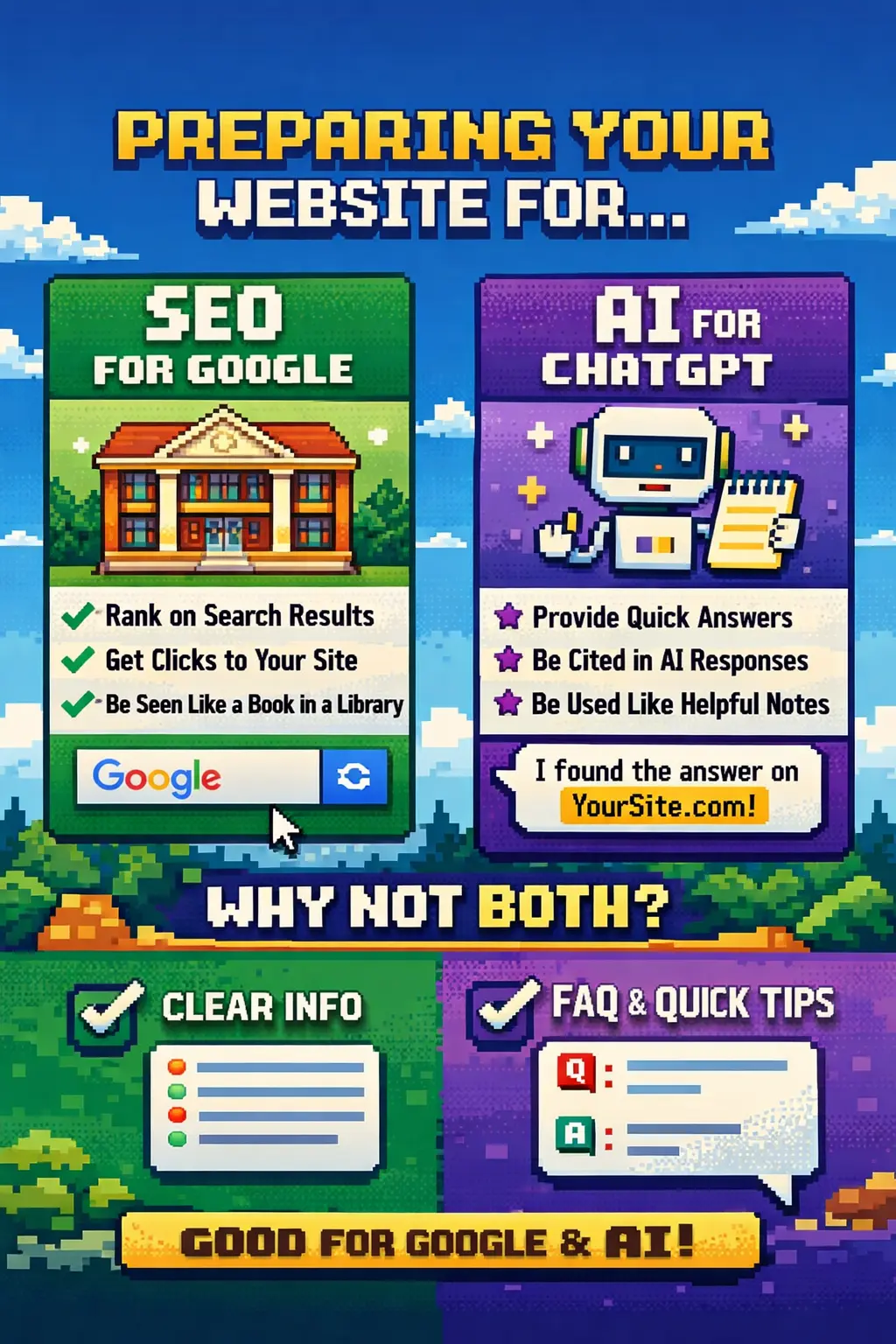
SEO helps people find your website through Google and click on it.
AI-readiness helps AI tools (like ChatGPT-style search experiences) understand your content and confidently use it in an answer — sometimes with a link, sometimes without.
Let’s break it down in plain language.
Think of it like this: a library vs a helpful friend
SEO is like getting your book into a library
Google is the library. SEO is how you make sure:
Your book is on the right shelf
It has the right title on the cover
The table of contents makes sense
People can find it when they ask for that topic
AI-readiness is like helping a friend answer questions fast
Now imagine a friend reads your book to answer questions for other people.
Your friend won’t read the whole book every time — they’ll grab the clearest parts:
definitions
quick bullet lists
step-by-step instructions
“FAQ-style” answers
So AI-readiness is about writing your content so it’s easy to extract and explain.
What’s the real difference?
✅ SEO focuses on ranking
SEO is mainly about:
Getting indexed (Google can see your pages)
Matching search intent (you answered what people searched for)
Showing quality (helpful content, trustworthy site)
Getting authority (other sites link to you)
The goal: appear high in search results and earn clicks.
✅ AI-readiness focuses on clarity + “snippability”
AI tools often work by scanning pages and pulling the best parts into a response.
AI-readiness is mainly about:
Clear answers that can be quoted or summarized
Clean structure (headings, short sections, lists)
Content that is accurate and up-to-date
Pages that explain “what, who, how much, where, how, why” quickly
The goal: be easy to understand and easy to reuse correctly.
What you must do to make your site SEO-ready
Here’s a simple, non-technical checklist you can follow.
1) Make sure Google can “see” your site
Even great content won’t rank if Google can’t access it.
Do this:
Your website should not block search engines accidentally
Important pages should load properly (no broken links, no “page not found” problems)
Your pages should work on mobile
Quick test:
Search Google for: site:yourdomain.com
If nothing shows up, you may have an indexing issue.
2) Create pages that match what people search for
This is where most SEO fails: the page exists, but it doesn’t match what users actually want.
For each main service or product, you should have a page that clearly answers:
What is it?
Who is it for?
What problems does it solve?
What’s included?
What’s the price range (if possible)?
How to contact you / buy / book
Example:
Instead of a vague page called “Services,” create:
“Kitchen Remodeling in Beirut”
“Wedding Photography Packages”
“Accounting for Small Businesses”
3) Use simple “SEO signals” on every page
Every important page should have:
A clear page title (the clickable blue title in Google)
One clear main heading at the top (your page headline)
Subheadings that organize the page (like a clean menu)
A short introduction saying what the page is about
For dummies tip:
If a visitor can’t understand the page in 10 seconds, Google often won’t either.
4) Make your website easy to navigate
Google favors websites that are organized and easy to explore.
Do this:
Put your important pages in the top menu
Use internal links (link from one page to another)
Avoid having pages “hidden” with no links pointing to them
5) Build trust
Google wants to recommend trustworthy businesses and content.
Do this:
Add an About page
Add a real Contact page (phone, email, location if relevant)
Add policies (Privacy Policy / Terms — especially if you collect leads)
Show real proof: testimonials, reviews, case studies, client logos
What you must do to make your site AI-ready for ChatGPT-style reading
Most of this is still “good content,” but the format matters more.
1) Write “answer-first” content
AI tools love content that gets to the point.
Bad (too vague):
“We are passionate about delivering solutions for modern businesses…”
Better (direct):
“We help small businesses set up bookkeeping, monthly reports, and tax-ready records in 7–14 days.”
Rule: Put the clearest answer in the first 2–3 lines.
2) Use headings that sound like real questions
Instead of headings like:
“Overview”
“Details”
“More information”
Use headings like:
“What is included in the service?”
“How much does it cost?”
“How long does it take?”
“Who is this for?”
“What do I need to get started?”
This makes your page easier for both humans and AI to scan.
3) Add a short FAQ section (this is gold)
Even if you don’t have a blog, add FAQs to your service pages.
Example FAQs:
“Do you work with businesses outside Lebanon?”
“What documents do you need from me?”
“Can I cancel anytime?”
“Do you offer support after delivery?”
These often become the exact answers AI tools reuse.
4) Use lists, steps, and mini tables
AI reads structured content better than big paragraphs.
Add:
Bullet lists for features
Numbered steps for “how it works”
Simple comparison tables (Package A vs B)
Example:
How it works
Book a call
We audit your current setup
You receive a plan + timeline
We implement + test
You launch
5) Keep key info in normal text (not only in images)
If your pricing, services, or process is only inside:
images
banners
PDFs
…AI and search engines may miss it or read it poorly.
Always include important information as real text on the page.
6) Keep facts consistent across your site
AI gets confused when your site contradicts itself.
Make sure these match everywhere:
business name
location
phone number
opening hours
pricing ranges
service areas
The overlap (good news)
If you do SEO well, you’re already halfway to AI-readiness.
Both SEO and AI prefer:
fast, mobile-friendly pages
clear structure
helpful, specific content
trust signals
updated information
AI-readiness is mostly: write in a clearer, more structured way.
A simple “done in 1 week” action plan
Day 1: List your top 5 money pages
(home, services, best-selling product/service pages, contact)
Day 2: Rewrite the top of each page with a direct “answer-first” intro
Day 3: Add 5–8 FAQs to each main service page
Day 4: Add “How it works” (numbered steps) to each service page
Day 5: Add trust signals (testimonials, About, clear contact details)
Day 6: Improve internal links (link between related pages)
Day 7: Publish 1 blog post that targets a real question customers ask
(Example: “How much does X cost in 2026?” or “How to choose X?”)
Final takeaway
SEO gets you found.
AI-readiness gets you understood and used in answers.
The best strategy is: build SEO basics first, then format content for clarity (FAQs, headings, lists, direct answers).
Ready to Start Your Project?
Get a personalized blueprint for your MVP with our AI-powered consultant.
Get Your Free Blueprint →Related Articles


Open Source CMS vs Custom CMS: Why Real Ownership Matters More Than a Closed System
March 7, 2026

Comments
Loading comments...